
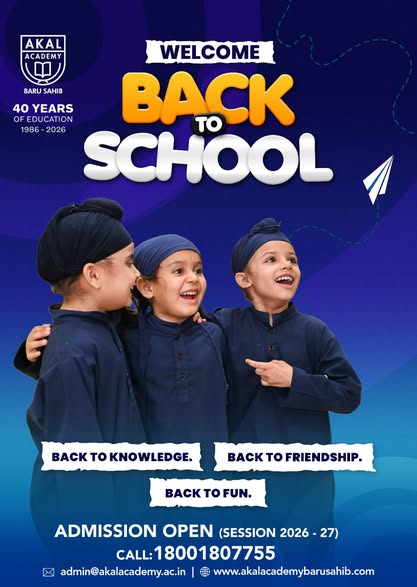
After the joyful holidays, our corridors are alive once again with laughter, cheerful chatter and bright faces.
A fresh term begins at our Modern Gurukul, filled with new lessons, friendships, and discoveries waiting to unfold.
Back to School. Back with Smiles!
Akal Academy Baru Sahib, celebrating 40 Years of Education (1986- 2026)
Fully Residential School | Coeducational | International Educational Boards
IB (Nursery–V) | Cambridge (VI–XII) | CBSE (Nursery–XII)
We invite inquiries for admission -
Register @ https://www.akalacademy.in/register
Call us – 18001807755
Website - www.akalacademybarusahib.com
WhatsApp us : 9816400510
Email Us - admissions@akalacademy.ac.in
Over a century ago, Sant Attar Singh Ji Maharaj envisioned a place in the Himalayas where children would grow into messengers of peace, nurtured through education rooted in spirituality, wisdom, and service to humanity.
That vision took shape at Baru Sahib and later blossomed into Akal Academy Baru Sahib, which today stands as a network of 131 Akal Academies serving rural India.
What began with just 5 children has grown into an educational movement that has empowered over 70,000 students across North India.
From villages to civil services, from farms to hospitals, our students continue to break generational barriers, carrying forward an education grounded in strong values and purposeful living.
The Spelling Bee Competition was recently conducted to provide students with international academic exposure. As an academic platform, the competition challenges students to spell words accurately while understanding pronunciation, meaning, phonics, and syllable structure. It strengthens vocabulary, refines diction, enhances clarity of speech, and sharpens attentive listening skills.
Beyond language development, the competition fosters the true spirit of healthy competition and builds confidence to perform under pressure. By deepening their understanding of word structure and sound patterns, students move closer to mastering a global language with precision and assurance.
Such competitions contribute to holistic development by ensuring that every child is given an equal opportunity to participate, learn and grow, so that no child is left behind.
Akal Academy Baru Sahib, celebrating 40 Years of Education (1986- 2026)
Fully Residential School | Coeducational | International Educational Boards
IB (Nursery–V) | Cambridge (VI–XII) | CBSE (Nursery–XII)
We invite inquiries for admission -
Register @ https://www.akalacademy.in/register
Website - www.akalacademybarusahib.com
Call us – 18001807755
WhatsApp us: 9816400510
Email Us - admissions@akalacademy.ac.in
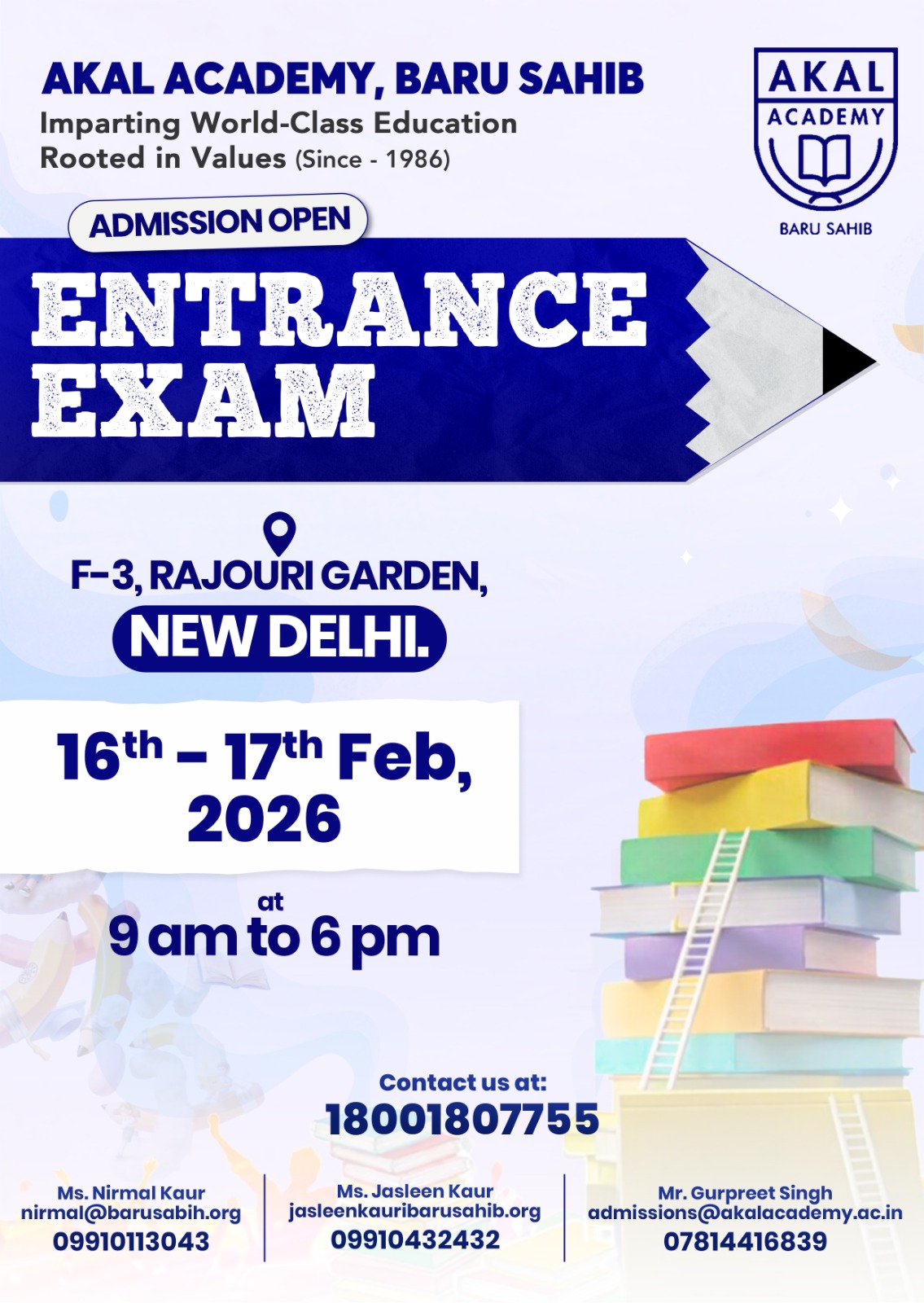
Akal Academy Baru Sahib is conducting its Entrance Test in New Delhi on 16th & 17th February at:
📍 F-3, Rajouri Garden, New Delhi. For more details, kindly contact – 18001807755.
Akal Academy Baru Sahib, situated in the valleys of the Himalayas and known as a Modern Gurukul, offers value-based spiritualised education along with international and national curricula such as IB, Cambridge, and CBSE, which blend the wisdom of ancient educational traditions with modern academic facilities.
Campus Highlights:
• 450-acre self-sustainable campus with an in-house hospital
• Spiritualised environment with Gurudwara Sri Baru Sahib within the campus
• Pollution-free and drug-free surroundings
• Safe and secure residential environment, especially for girls
• Expansive playgrounds – Hockey, Football, Tennis, Basketball &
Badminton courts
• State-of-the-art labs – Kinesthetic Lab, Maths Lab, Physics, Chemistry & Biology Labs
• Yoga Room & Martial Arts Training Room
• Traditional Akhada
• In-house bakery & central kitchen serving nutritious meals
• In-house laundry facilities
Give your child an education rooted in values, discipline, and global academic standards.
📞 For details and registration, connect with us today.
Register for admissions: https://www.akalacademy.in/register
Call us @ 18001807755
Website: www.akalacademybarusahib.com
WhatsApp: 9816400510
Email ID – admissions@akalacademy.ac.in
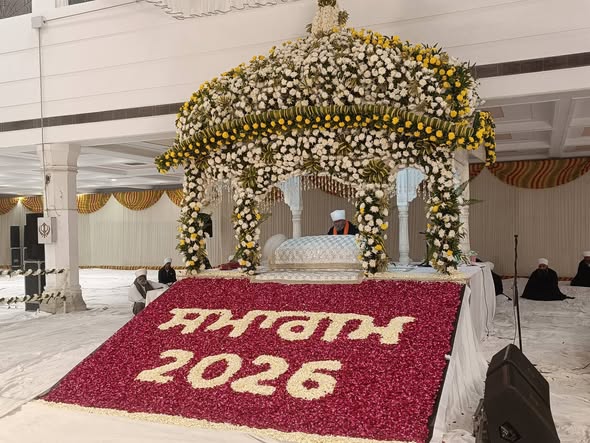
The Annual Sant Samagam officially commenced at 2:30 AM today at Gurdwara Rakab Ganj Sahib, Delhi.
In the loving memory of the Great Visionary, Sant Attar Singh Ji (Mastuana Sahib Wale), the atmosphere was transformed by the Prakash of Sri Guru Granth Sahib Ji and the soul-stirring Waheguru Simran by the students of Gurmat Sangeet Vidhalya, Baru Sahib.
This is a 2-day program of deep meditation and Gurbani. If you haven't joined yet, the spiritual vibrations are just beginning to unfold.